
| Home | City Bus | Maps | Villages | Cities | Rail | Tourist Places | School | College | Pin Codes | Corona Cases Count |
| Distance Calculator Bus Services IFSC Codes Trace Mobile Number Weather Search Place Trace IP Available Cash ATM/Banks Locate Polling Booth Report an Error contact People |
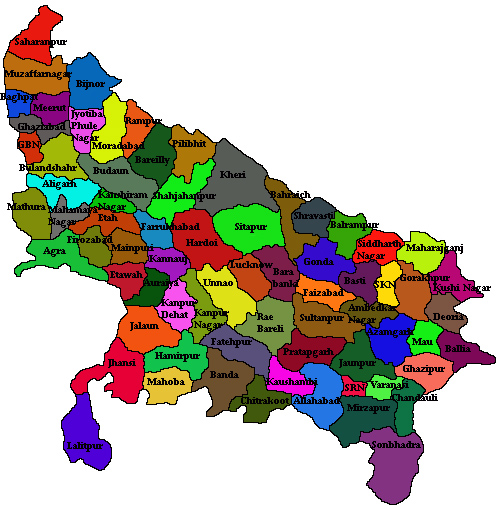
List Of Districts in Uttar Pradesh
|
Current Corona Virus Infected Patients Total Count in Uttar Pradesh
| City Name | District Name | Covid Positives cases |
|---|---|---|
| Agra District | Agra | 24 |
| Lucknow District | Lucknow | 18 |
| District | 16 | |
| Meerut District | Meerut | 13 |
| Shamli District | Shamli | 12 |
| Ghaziabad District | Ghaziabad | 11 |
| Sitapur District | Sitapur | 9 |
| Bulandshahr District | Bulandshahr | 5 |
| Ghazipur District | Ghazipur | 4 |
| Hathras District | Hathras | 4 |
| Gautam Buddha Nagar District | Gautam Buddha Nagar | 4 |
| Basti District | Basti | 3 |
| Mirzapur District | Mirzapur | 3 |
| Varanasi District | Varanasi | 3 |
| Firozabad District | Firozabad | 3 |
| Mathura District | Mathura | 3 |
| Bijnor District | Bijnor | 2 |
| Hapur District | Hapur | 2 |
| Budaun District | Budaun | 2 |
| Rae Bareli District | Rae Bareli | 2 |
| Banda District | Banda | 2 |
| Bhadohi District | Bhadohi | 1 |
| Moradabad District | Moradabad | 1 |
| Sultanpur District | Sultanpur | 1 |
| Muzaffarnagar District | Muzaffarnagar | 1 |
| Kanpur Nagar District | Kanpur Nagar | 1 |
| Prayagraj District | Prayagraj | 1 |
| Kaushambi District | Kaushambi | 1 |
| Auraiya District | Auraiya | 1 |
| Etawah District | Etawah | 1 |
| Saharanpur District | Saharanpur | 1 |
| Azamgarh District | Azamgarh | 1 |
| Sant Kabir Nagar District | Sant Kabir Nagar | 1 |
|
|
Uttar Pradesh is the land of diversity. In 1935, British Indian government formed united province by merging Agra and Awadh regions. the capital of Uttar Pradesh is Lucknow. United Province became today’s UP in January, 1950- after independence. UP faced further problems in 1994, when demands were raised for a separate Uttaranchal with the Garhwal and Kumaon regions. UP has Uttaranchal to its North; Haryana at west; Rajasthan at South and Bihar in the East. Area wise UP is the fourth largest state but has the population. Geographically it has two distinctive features the Southern Plateau and the Plains along the Gangetic basin.
With the Himalayas at its north and the Shivalik ranges at its south, UP is a paradise for pilgrims and travelers. Agra with her Taj is a wonder of the world. The four major pilgrims of the world as mentioned in the Purana are- Badri, Kedar, Gangotri and Yamunotri are in UP and draws a huge crowd of pilgrims. Three of the seven holy places of the Hindus – Varanasi, Ajodhya and Mathura- are all here. UP has it all Vrindhavan, Prayag (Allahabad) at the confluence of three rivers- Ganga, Yamuna and Saraswati which are considered to be the holy rivers. It doesn’t have mountain or sea around. The dearth of sea and mountain is compensated by two holy rivers- Ganges and Yamuna which come down from Gangotri and Yamunotri and keep flowing through the plains. Four more rivers- Ghaghara, Gomti, Koshi and Ramganga come all the way from north and meet with the Ganges here. Places of mythological importance and scenic splendor have been attracting millions of people through ages. UP has always been known as place or pilgrimages and gateway to Deva bhoomi in Himalayas. But equally known are the practices or fleecing the pilgrims at Kashi, Prayag and Vrindavan.
Travelling in India is incomplete without visiting UP which is topper in tourism map. Lucknow fondly called the Golden city of the east or the city of Adab. Lucknow is the heart of UP and unique by itself. Gomti the tributary of Ganges cuts through the city. The evening in Lucknow is as famous as the morning of Varanasi. All the tourists those who visited Lucknow fell in love with the place and expressed in beautiful words the trance it led them into. The cultural heritage of Lucknow was simultaneously shared by the Hindus and Muslims. The acculturation is still now evident in every facet of life. The age old cultural continuum has stood through time even in the face of an all pervasive globalization. Bada Imambara, the 4 storey marvel was constructed by Khifayatulla, an Iranian architect and has a strange labyrinth Bhulbhulaiya on top of it. It is the world’s biggest dome shaped hall. One may lose way inside it without a guide. There are 84 steps to take the tourists to a height that offers a panoramic view of the city. Juma Masjid, another glorious deed of the Nawab is at its west. It has three onion shaped minarets. It has a zoo, which has a wide collection of snakes. There are elephant rides and toy train services to the Botanical garden. The collection of Dolls at Motilal Nehru Childrens Museum is worth seeing. Akbar’s Fort in Allahabad is another foremost attraction of this state. It is surrounded by strong ramparts and 7m high walls of red stone, the fort has three entrances.
Demography-
People of this place is involved in different professions such as painters, dancers, doctors, engineers, dramatists, IT-Professionals, business etc. the literacy rate in this state is 57%. Hindi, Urdu and English are the main languages of this state. People of different religions are also found here.
Climate-
Autumn is the best time to visit this state. Flowers add to the beauty of this state during May-July. The tropical climate varies between 27C in winter and 48C in summer. Again there are places where mercury drops dips down to 10C during monsoon in June-September.
********