
| Home | City Bus | Maps | Villages | Cities | Rail | Tourist Places | School | College | Pin Codes | Corona Cases Count |
| Distance Calculator Bus Services IFSC Codes Trace Mobile Number Weather Search Place Trace IP Available Cash ATM/Banks Locate Polling Booth Report an Error contact People |
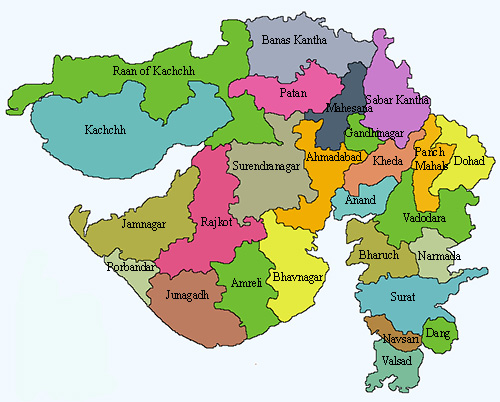
List Of Districts in Gujarat
|
Current Corona Virus Infected Patients Total Count in Gujarat
| City Name | District Name | Covid Positives cases |
|---|---|---|
| Bhavnagar District | Bhavnagar | 2 |
| Gandhinagar District | Gandhinagar | 2 |
| Rajkot | Rajkot | 2 |
| Patan District | Patan | 1 |
|
|
Gujarat is gradually finding its place on the map of tourism; both domestic and foreign tourists are visiting the state in increasing numbers. The capital of Gujarat is Gandhinagar. One should indeed cover Gujarat, the jewel in the West, on one’s tour of Mumbai and Rajasthan. Gujarat has a wide variety of attractions. It is the land of the Gurjars. In course of time the state of Gurjars has came to be known as Gujarat. Gujarat was a port of Maurya empire during 3rd century. Around 5th century the Maurya empire fell under the invasion of Huns and Gurjars migrated to this area from the Northern quarter of India. Gujarat came under the rule of the Gupta dynasty around 4-5th century and under the Solanki dynasty around 9th century. In 10th century Chalukya King Mulraj Solanki laid the foundation of modern Gujarat.
Archaeologist claims that Gujarat was the base of Indian civilization even before 5000 years. Around 2500 BC, Harappans from Punjab travelling past the Runn of Kutch entered Gujarat and settled down the Narmada valley. The Sun temple of Madhera founded by Sampreeti is equally an attractive place both to the devout and tourist. Farther south Somnath is another holy place for Hindu pilgrimage. Gujarat claims its glorious position in the annals of Indian history by virtue of its own splendor.
The political and social turmoil in 19th century encouraged many Gujarati to migrate to the other parts of the world. Many of them has domiciled in East Africa- others have settled in England, Canada, New Zealand and other parts of the world. Gujarat played a major role in India’s struggle for independence. Mohandas Karamchand Gandhi- Father of the Nation- was born at Porbandar at Gujarat. The place is said to be a holy one.
Gujarat has many beautiful places for the tourists to explore. The Gir Forest in Gujarat famous for lions in Asia as is equally famous the life style of gypsies in color gay at the Runn of Kutch in Gujarat. Similarly, forested by various kings, nawabs and thakurs the sea beaches of Gujarat- Chorwad and Ahmedpur- Mandvi are unique. A 1650km long coastal belt encircles Gujarat. Even the remote parts of Gujarat are within 150km from the coast. Gujarat is still the leading state in textile industry. A huge reserve of oil has also been spotted at Cambay in Gujarat. The state is served by various rivers such as Sabarmati, Mahi, Narmada, Tapti and other rivers that help to produce tobacco leaves, cotton, and groundnut on a huge scale.
During the Rash festival in Gujarat witnessed a riot of colors as whole community erupts in gay celebrations. Women wear choli with sari and men wear open collar long Punjabi with trouser. The tourists can also share Garba dance enacting the romance of Lord Krishna with Gopi balas. Pankhira Dance is also an essential part of the festival.
Geographical conditions have dived Gujarat in 3 different geographical location 1) Main lands: Surat, Vadodara and Ahmadabad are industry-based commercial cities. 2) 430*320 km area and about 200m high Kathiawad of the past or Saurashtra on the right little Runn of Kutch. The area melts in to the desert and beyond it stretches Pakistan.
Demography-
The main language of Gujarat is Guajarati, both Hindi and English are in use as well. Gujarat is 7th in size and 10th in population in India. The literacy rate in Gujarat is 70%. 20% of the state populations are tribal as well as Dalits or lower caste Hindus. Jain religion predominates the state. They are the friend and lover of animals. Traditionally Gujarati people, particularly Hindus and Jain are vegetarians, due to Jain influence and orthodox Hinduism.
Climate-
An ideal time for the tourist to visit Gujarat is during October-March. Temperature varies between 55-95F. Variable temperature increases from April- excessive heat from April to September. Rain causes trouble in south and western Gujarat. And north of Gujarat is the desert area.
********