
| Home | City Bus | Maps | Villages | Cities | Rail | Tourist Places | School | College | Pin Codes | Corona Cases Count |
| Distance Calculator Bus Services IFSC Codes Trace Mobile Number Weather Search Place Trace IP Available Cash ATM/Banks Locate Polling Booth Report an Error contact People |
Head Quarters : Godhra
Language : Gujarati and Hindi
Area: sq. km
Population : 2388267
Sex Ratio : 945
Density : 458/ sq. km
Literacy : 72.32
Elevation / Altitude: 92 - 107 meters. Above Seal level
Current Time 12:49 PM
Date: Thursday , Jan 01,2026 (IST)
Time zone: IST (UTC+5:30)
District Pin code Index: 388XXX,389XXX
Vehicle Registration Number: GJ-17
RTO Office: Panchmahal (Godhara)
Language : Gujarati and Hindi
Area: sq. km
Population : 2388267
Sex Ratio : 945
Density : 458/ sq. km
Literacy : 72.32
Elevation / Altitude: 92 - 107 meters. Above Seal level
Current Time 12:49 PM
Date: Thursday , Jan 01,2026 (IST)
Time zone: IST (UTC+5:30)
District Pin code Index: 388XXX,389XXX
Vehicle Registration Number: GJ-17
RTO Office: Panchmahal (Godhara)
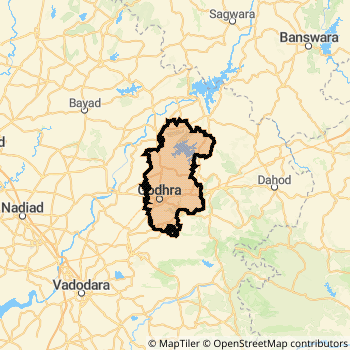
Panch Mahals District Map
Current Corona Virus Infected Patients Count in Panch Mahals District
| City Name | District Name | Total Covid cases |
|---|
Panch Mahals Live Weather
Temperature: 24.2 °C
clear sky
Humidity: 56%
Wind : 2.59 mt/sec towards SW
StationName : "Godhra"
observed on 1 Hours Back
Temperature: 24.2 °C
clear sky
Humidity: 56%
Wind : 2.59 mt/sec towards SW
StationName : "Godhra"
observed on 1 Hours Back
Panch Mahals Weather Forecast for Next 5 days
02-01-2026
18.7°C to 26.6°C
clear sky, scattered clouds, overcast clouds
18.7°C to 26.6°C
clear sky, scattered clouds, overcast clouds
03-01-2026
17.0°C to 27.6°C
clear sky
17.0°C to 27.6°C
clear sky
04-01-2026
15.6°C to 28.2°C
clear sky
15.6°C to 28.2°C
clear sky
05-01-2026
16.2°C to 29.1°C
clear sky
16.2°C to 29.1°C
clear sky
06-01-2026
16.7°C to 29.6°C
clear sky
16.7°C to 29.6°C
clear sky
Temples in Panch Mahals
Historical Daily Max Temperatures (Next 7 Days)
| Years | 01 Jan | 02 Jan | 03 Jan | 04 Jan | 05 Jan | 06 Jan | 07 Jan |
|---|---|---|---|---|---|---|---|
| 2025 | |||||||
| 2024 | |||||||
| 2023 |
About Panch Mahals District
Panch Mahals District is one among 25 Districts of Gujarat State ,India. Panch Mahals District Administrative head quarter is Godhra. It is is Located 130 KM west towards State capital Gandhinagar . Panch Mahals District population is 2388267. It is 9 th Largest District in the State by population.Geography and Climate Panch Mahals District
It is Located at Latitude-22.7, Longitude-73.6. Panch Mahals District is sharing border with Dohad District to the East , Kheda District to the west , Sabar Kantha District to the North , Vadodara District to the South . . Its in the 92 meters to 107 meters elevation range.This District belongs to Western India .DemoGraphics of Panch Mahals District
Gujarati is the Local Language here. Also People Speaks Hindi . Panch Mahals District is divided into 12 Talukas , 577 Panchayats , 3502 Villages. Jambughoda Taluka is the Smallest Taluka by population with 36319 population. Shehera Taluka is the Biggest Taluka by population with 231325 population.Census 2011 of Panch Mahals District
Panch Mahals district Total population is 2388267 according to census 2011.Males are 1227901 and Females are 1160366 .Literate people are 1580077 among total.Its total area is sq.km. It is the 9 th largest district in the state by Population . But Largest District in the state By Area. 186 th Largest District in the Country By Population. 22 nd highest District in the State By literacy rate. 336 th highest District in the Country By literacy rate.its literacy Rate is 72.32Politics in Panch Mahals District
Bharatiya Janata Party , BJP , INC are the major political parties in Panch Mahals District.Assembly constituencies in Panch Mahals District
Total 8 Assembly constituencies in Panch Mahals District.| Constituency name | MLA name | Party |
|---|---|---|
| Lunavada | Gulabsinh Somsinh Chauhan | INC |
| Santrampur | Dr. Kuberbhai Mansukhbhai Dindor | INC |
| Shehra | Ahir(Bharvad) Jethabhai Ghelabhai | BJP |
| Morva Hadaf | Suthar Nimishaben Manharsinh | BJP |
| Godhra | C.K.Raulji | BJP |
| Kalol | Fatesinh Vakhatsinh Chauhan | BJP |
Parliament constituencies in Panch Mahals District
Total 3 Parliament constituencies in Panch Mahals District.| Constituency name | MP name | Party |
|---|---|---|
| Panchmahal | Ratansinh Magansinh Rathod | Bharatiya Janata Party |
| Chhota Udaipur | RATHVA GITABEN VAJESINGBHAI | Bharatiya Janata Party |
| Dahod | JASHVANTSINH SUMANBHAI BHABHOR | Bharatiya Janata Party |
Panch Mahals District Political Map
Panch Mahals Commerce
Total Registered Comapnies with Ministry of Corporate Affairs (MCA) in Panch Mahals are 212Company Name : LAVA CAST PRIVATE LIMITED
Type Of Business : Manufacturing (Metals & Chemicals, and products thereof)
Capital : 97.06 Crores
Company Name : CVG SEATING (INDIA) PRIVATE LIMITED
Type Of Business : Manufacturing (Others)
Capital : 96.5052 Crores
Company Name : WINDAR RENEWABLE ENERGY PRIVATE LIMITED
Type Of Business : Business Services
Capital : 49.7446 Crores
Company Name : RAJPUTANA STAINLESS LIMITED
Type Of Business : Manufacturing (Metals & Chemicals, and products thereof)
Capital : 34.4588 Crores
More Panch Mahals Registered Companies
Panch Mahals District Tourism
Champaner , Pavagadh , Sultan s Palace , Halol gate , Delhi gate , Godhra gate , Raval Palace , Machi Haveli , Teliya Talav , Dudhia Talav , are the Tourist destinations to Visit.
Panch Mahals Transport
Road Transport
District Headquarters Godhra is well connected by road . Lunawada , Godhra are the Cities in this district having road connectivity to major towns and remote villages. Godhra is about 130 KM by road to Gandhinagar( Capital of Gujarat )Rail Transport
Some of the rail way stations in district are Godhra Junction , Derol , Tuwa , Vavadi Khurd , Kharsaliya , Champaner Road , Bodeli , Chanchelav .... which connects most of the towns and villages in the District.Bus Transport
Gujarat State Road Transport Corporation ( GSRTC) runs Busses from Major cities to Towns and Villages in this District.
Pin Codes in Panch Mahals District
389232
( Bakor ) ,
389370
( Shivrajpur ) ,
389120
( Sant Road ) ,
389365
( Ghoghmba ) ,
388713
( Kakanpur ) ,
389230
( Lunawada ) ,
389340
( Vejalpur ) ,
389001
( Godhra ) ,
389330
( Kalol (Panch Mahals)) ,
388270
( Vardhari ) ,
389320
( Derol R S ) ,
389390
( Jambughoda ) ,
389260
( Santrampur ) ,
389240
( Kadana ) ,
389341
( Adadra ) ,
389250
( Diwda Colony ) ,
389115
( Morva Hadaf ) ,
389360
( Pavagadh ) ,
389350
( Halol ) ,
389110
( Mora (Panch Mahals)) ,
more PinCodes
Hotels in Panch Mahals
BusStops in Panch Mahals Lakes in Panch Mahals Temples in Panch Mahals Shops in Panch Mahals Panch Mahals Hospitals Hotel/Restaurants in Panch Mahals Panch Mahals RailwayStations Panch Mahals BusStops ATM in Panch Mahals
Near Cities
Godhra 1 KM near
Lunawada 45 KM near
Umreth 58 KM near
Kapadvanj 70 KM near
Near By Air Ports
Vadodara Airport 71 KM near
Ahmedabad Airport 120 KM near
Bhavnagar Airport 208 KM near
Dabok Airport 232 KM near
Near By Districts
Panch Mahals 0 KM near
Dohad 73 KM near
Vadodara 78 KM near
Anand 80 KM near