
| Home | City Bus | Maps | Villages | Cities | Rail | Tourist Places | School | College | Pin Codes | Corona Cases Count |
| Distance Calculator Bus Services IFSC Codes Trace Mobile Number Weather Search Place Trace IP Available Cash ATM/Banks Locate Polling Booth Report an Error contact People |
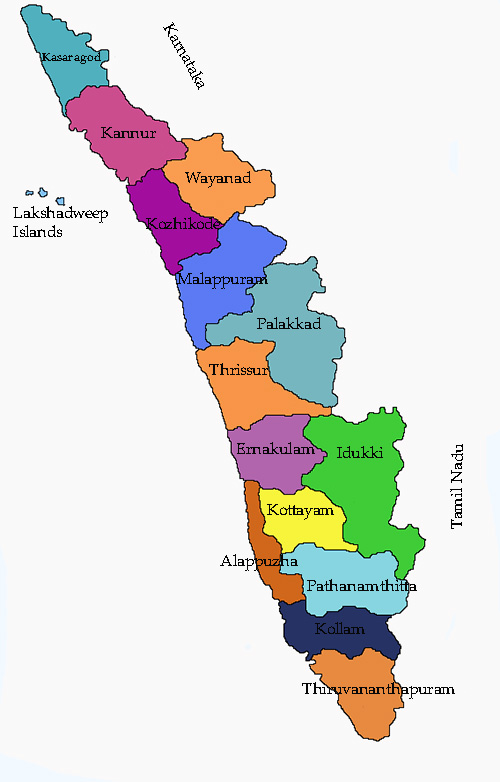
List Of Districts in Kerala
|
Current Corona Virus Infected Patients Total Count in Kerala
| City Name | District Name | Covid Positives cases |
|---|---|---|
| Alappuzha District | Alappuzha | 1 |
| Ernakulam District | Ernakulam | 1 |
| Kannur District | Kannur | 1 |
| Kollam District | Kollam | 1 |
| Palakkad District | Palakkad | 1 |
|
|
Kerala is the God’s own country. This state of India is situated on the South West coast of the country. The shape of the state is most likely to draw the attention of the people. Sickle-like in shape, Kerala on map looks like a crescent moon as it appears on the eleventh day of lunar eclipse. The capital of Kerala is Thiruvananthapuram which is almost located on the border of Tamil Nadu’s Padmanavapuram. Kerala is one of the 50th travel-worthy places on earth. Only two Indian places figure in the list. Interestingly Kerala is ahead of Taj Mahal in this list. Pollution free Kerala is magnificent, a place of beauty and unique culture. Kerala is the most educated state of India with a literacy rate of 90%. A peculiar feature of Kerala is that here women have over taken men in number, perhaps for the fact that men has largely gone out of the state in search of job. It is therefore no surprise that Malayalam-speaking people of Kerala, known as Malayalees, are seen working in large numbers in oil-rich Arab countries. The state consists of Travancore, Malabar, Cochin and south Canara district of Karnataka all of which were parts of Madhya Presidency during British rule.
Nature is bountiful in Kerala. It is, however, deprived of any hill towns and resorts. Water and greens make this beautiful state similar to Bengal. Blue waves of the Arabian Sea lash the western shores of Kerala while the evergreen eastern part is extended up to Masala hill on the western Ghat range of mountain. Kerala is adequately provided with hills, forest, canals, creeks and troves of coconut trees. The splendor of nature also becomes apparent when one sees Kovalam beach, Periyar wildlife sanctuary and backwater created by the sea looking like creeks. The backwater whispers as wave turns into uncountable number of bubbles. Kerala is very attractive and at the same time less expensive a place to visit. As many as 44rivers flow down Kerala and there are sub lakes, deltas and estuaries spread all over Kerala. Kerala is called the Venice of East. There is a great diversity in nature of this state and in its history.
Kerala is also rich in cultural expressions like dancing and music. The tribal dance of north Kerala, Theyyam and Kalaripayattu of the Nair’s are as old 1000year. The episode of Ramayana, Mahabharata, and other literatures of olden days had been woven together to give the famous Kathakali dance more than 400 years ago. Sanskrit dance is also performed here with 9m high masks are appreciated the world over. Kerala has contributed greatly to the development of Karanataki music.
The Elephant March is a yearly festival that is quite popular in Tiruvananthapuram. Thousands of tourists gather here to watch the colorful procession of 101 elephants. The elephant carries a huge umbrella on its back. Tourists may also enjoy riding. Boat Race another popular festival of Kerala is celebrated on the 2nd Saturday of August of every year. More than 100 boats with 100 oars each take competition in the race. The boat race is the major attraction of the tourists. Temples, mosque and churches have dotted almost everywhere in Kerala.
Demographic-
The literacy rate in Kerala is 90%
and the density of population is 819 per sq km. the main language of this state
is Malayalam, a combination of Sanskrit and Dravid along with Tamil and
English. Keralites are highly disciplined and sincere to their work. Kerala was
created as a linguistic state on 1 November, 1956 with Malayalam as the state
language. It is the 12th state in terms of population. Kerala is
quite developed in agriculture, education and health care.
Climate-
An ideal time for the tourists to visit the place is during October to March, however November to February is equally good. The tourists must avoid visiting the place during monsoon from May to November, but the tourists may tour round the year. There is no excessive heat in Kerala. Maximum temperature here is 33C and minimum 22C.
********