
| Home | City Bus | Maps | Villages | Cities | Rail | Tourist Places | School | College | Pin Codes | Corona Cases Count |
| Distance Calculator Bus Services IFSC Codes Trace Mobile Number Weather Search Place Trace IP Available Cash ATM/Banks Locate Polling Booth Report an Error contact People |
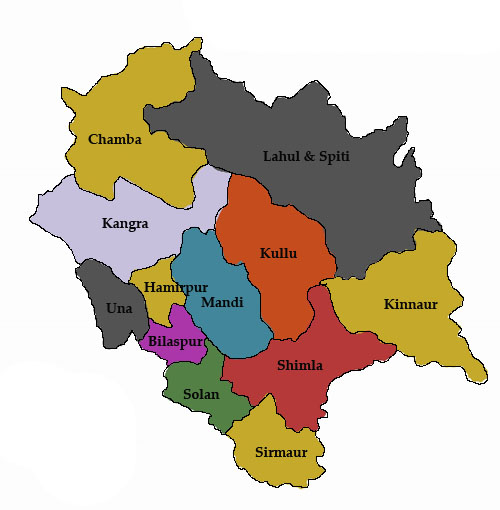
List Of Districts in Himachal Pradesh
|
Current Corona Virus Infected Patients Total Count in Himachal Pradesh
| City Name | District Name | Covid Positives cases |
|---|
|
|
The Puranas describe it as the Mahahimavanta or the great Freezing Zone; to us it is known as Himalayas. Geologist has dating its origin 6 crorer years, two third of the Himalayas is still in the subterranean depth. The capital of Himachal is Shimla. In the course of time racial intermixture with the Aryans led to the formation of a number of tribal settlements in respective states. The entire region saw the rise and fall of the Guptas, the Bardhans, the Ranas and the Thakurs as the sovereign power within a time frame of 2-5 century BC. The advent of the Muslims had rocked the Himachal by the 10th century. On 15th April 1948, Himachal Pradesh secured its political identity as a centrally administered state born out of the amalgamation of 30 hilly states with the mountainous part of the Punjab. Situated on the low ridges of the Sivalik, Himachal Pradesh has Himalayas in the North East, the Dhauladhar range in the N-West and the Sivalik in the south to mark its boundaries.
The Himachal Pradesh Tourist Department record 136 peaks of more than 5000m altitude, most colorfully sensitive in response to sun and moonlight variations and preparing visual feasts. The Himachal has the magical charm to allure thousands of tourists from all over India and abroad every year. The Himachal teems with scenic wonders as abundant as its forest resource. The caves in Himachal are natural zoos. Numberless birds, both familiar and strange, call to set the undulating paths and stretches a ringing with avian music. In its snowy region sight of brown and black bears, snow leopards are not absurd. Thousands of rivers n addition to the Irawadi, Bipasha, Chandravaga and Satadru stream down from the Himachal. The Himachal Pradesh was the holy place of renowned sanctity in the past. The unpredictable shifts from the fair frolic of sunny clouds to sudden devastations of hailstorms, hailstone and avalanches are quite confusing. Still trekkers carry on their expeditions to several directions along the Himalayas from the middle of May to mid October. Daring adventurers climb on the Himalayan peaks charming its intoxicated beauty. The State Museum of Shimla and the Shimla Kali Bari are the two main attraction of this place. Enthusiast may get down by a downward slope from Kunzum and visit the bluish water Chandratal Lake. The transparent blue water is bordered with sands and green grass. Rohtang Pass 51km away from Manali is another foremost attraction of this place. Manali, another place of interest in Himachal is a city to the north of Kullu valley.
Demography-
The principal language of Himachal Pradesh is Hindi. Other languages spoken here are Hilly dialect, Punjabi and English. The per capita annual income of this state is Rs 4005 (1989-90). Area wise the 17th largest state of the Indian Union, Himachal Pradesh ranks 20th in terms of population. Himachal casts extensive pantheons of 2000 deities, of whom the most prominent and popular are Lord Buddha. Though a Hindu state from the majority point of view, secular Himachal houses Buddhists and other minorities like Sikhs, Muslims and Christianity without any bias.
Forestry, orchids and tourism contributes to the major economic support for Himachal. 15% of the land constitutes the cultivation ground for wheat, paddy, maize and barley.
Climate-
The best season for the tourist to visit Himachal Pradesh is April to October. November to March makes the winter season when the entire Himachal Pradesh hibernates under snow and the temperature falls down to 18.33-5.55C. It is nothing unusual to find Shimla, Manali or the greater altitudes freezing on and off down to much below 0C. The summer temperature varies from 32-11C.
********